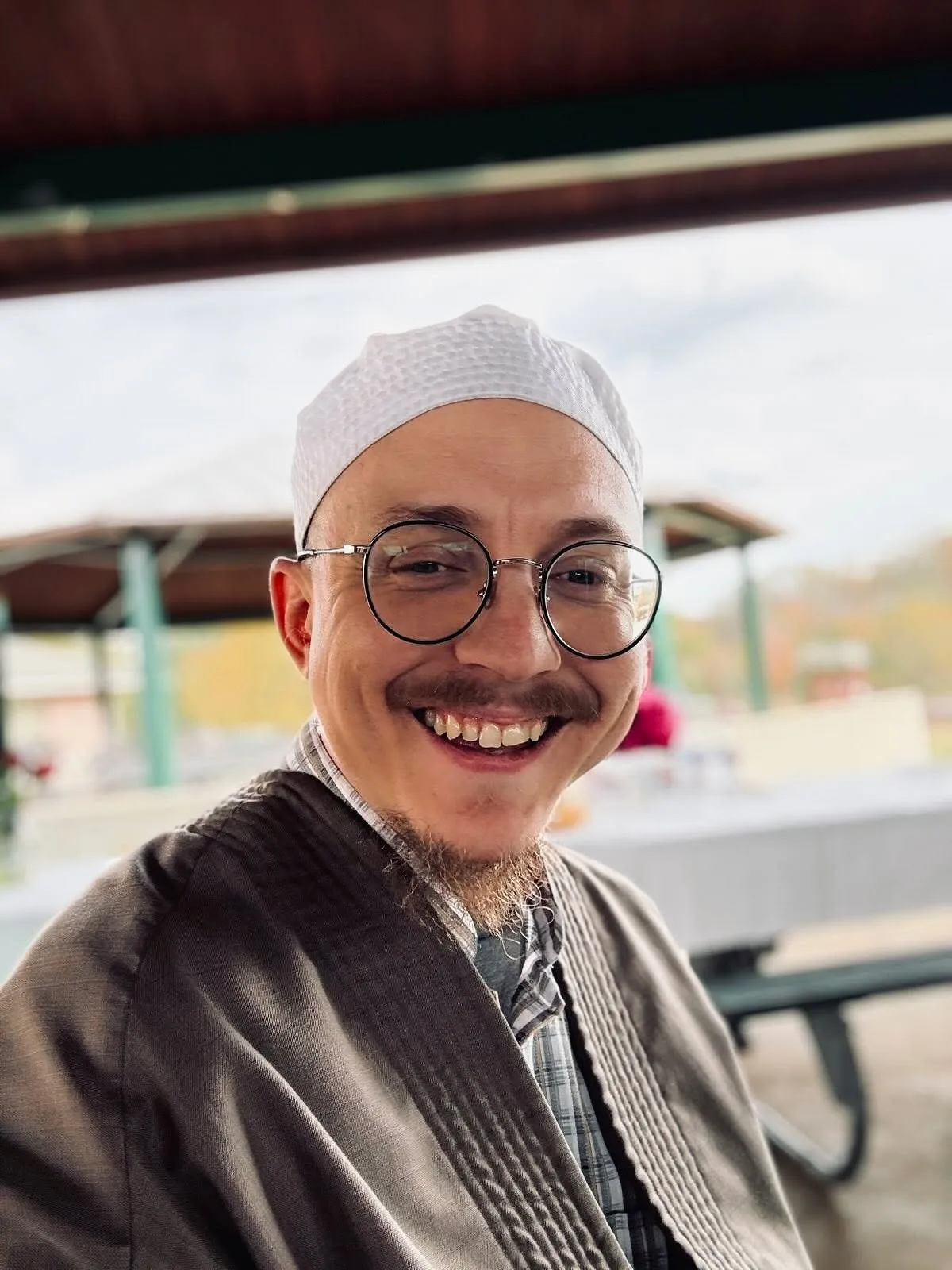
Muhammad Jameel was brought to Islam in 2010 in Scranton, Pennsylvania. Through Brothers Enrique Muhammad and Demario Muhammad, he was introduced to the esoteric sciences, the Qur’an, Sufism, and the teachings of the Honorable Elijah Muhammad. In February 2010, he was invited to watch and listen to the Honorable Minister Louis Farrakhan deliver the Saviours’ Day address. It was only the second time he had heard the Minister’s voice, but the address awakened something decisive within him. He came to believe in the Minister and his message, accepted Islam, and began his spiritual journey.
Drawn to the science of the heart at the center of the classical Sufi tradition, he was guided to a Naqshbandi dhikr circle in Connecticut, where he was then living. He later made several trips to Michigan to visit Mawlana Shaykh Hisham Kabbani and eventually moved there to remain close to Mawlana and the Naqshbandi Sufi Order. He attended weekly gatherings of dhikr, spent time in the companionship of many beautiful murids, and offered what service he could.
Through the Naqshbandi path, he learned about the snares of the ego, the ruinous characteristics that corrupt human character, and the spiritual disciplines through which those tendencies may be confronted and overcome. He also came to understand more deeply the meanings of service, companionship, humility, and love.
His writing stands at the meeting point of these two inheritances. He is the author of three books: Sufism & the Nation of Islam, a study of the affinities between the teachings of the Honorable Elijah Muhammad and the classical Sufi path; Death of the Scholars, an elegy for a vanishing generation of sacred learning; and Religious Exemption, an examination of conscience, law, and the believer’s duty when the two come into conflict.
He writes for those who seek spiritual taste rather than mere “book knowledge.” Although he provides sources and footnotes where appropriate, his work is addressed primarily to the heart rather than the intellect alone. He is guided by the conviction that the inner dimensions of faith belong to anyone willing to become still enough to receive them.
He lives and writes in Chiapas, Mexico.
"Whenever a new fruit comes, the taste of the previous fruit does not remain." — Shams-i Tabrizi